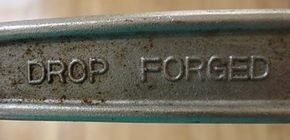
You buy a wrench. You pick up a hammer. You see that tiny stamp on the handle: Drop Forged.
It’s everywhere. But does it actually matter?
Or is it just marketing noise for gearheads who want to feel superior at Home Depot?
Here is the reality. The stamp isn’t just a logo. It tells you exactly how that piece of metal was born. And it matters for your safety and your wallet.
Drop forging is an old-school manufacturing process. It’s not new. It’s ancient, really. Think of a blacksmith in a village square. Red-hot iron. Heavy hammer. Clang. He beats the metal until it holds the shape he wants.
Modern factories do the same thing. Just faster. And with machines that weigh tons.
The Process: Heat, Hammer, Shape
When you see drop forged, it means the manufacturer took a chunk of steel, heated it until it was malleable, and then smashed it into a metal mold (a die).
They use either a falling hammer or a powered hammer. Sometimes they use dies on both sides. The impact forces the hot metal to fill every corner of that die.
This isn’t just about shape. It’s about structure.
When you cast metal (pour molten liquid into a mold), the grains are random. Messy. Weak points form where the liquid cools unevenly.
When you machine metal (cut it from a solid block), you’re just removing material. You’re left with the internal structure of the original bar.
Forging changes the grain.
The hammer blows align and stretch the metal’s grain structure. It flows along the contours of the tool. This makes the part denser. Stronger. More durable.
A forged wrench won’t snap under the same torque that would strip a cast one.
Forging Methods Compared
Not all forging is the same. Manufacturers use a few different techniques depending on the tool.
- Drop Forging: Hammering hot metal into dies. High impact. Great for complex shapes and high strength.
- Press Forging: Hydraulic pressure pushes hot metal into a die. Slower. More uniform density, but often less grain refinement than impact forging.
- Roll Forging: Hot metal passes between rollers. Good for long, uniform shapes like axles.
- Cold Forging: Pressing metal into a die without heat. Used for small, simple parts like bolts. Saves energy, but limits complexity.
Most hand tools you use around the house—hammers, wrenches, pliers—are drop forged. Why? Because they take abuse.
Why It Matters to You
You don’t need a metallurgy degree to know that a broken tool is a safety hazard.
Drop forging produces parts that are more robust than cast or machined alternatives. The aligned grain structure resists shock. It resists fatigue.
If you’re swinging a hammer at a nail 50 times a day, you want the metal to hold together.
High-stress tools benefit most. Think:
- Hammers
- Wrenches
- Axes
- Chisels
These tools face sudden impacts. A cast version might chip. A drop-forged one will likely dent, but it won’t shatter.
How Drop Forging Compares to Press Forging
You might see “Press Forged” on some tools. How does it differ?
Drop forging uses impact forces. These forces refine the grain structure more aggressively. Press forging uses steady pressure. It’s efficient. But it doesn’t always achieve the same level of strength in high-impact applications.
For most DIYers, drop forged is the gold standard for durability.
It’s not about being fancy. It’s about physics. The metal is worked. It’s hardened. It’s ready for work.
Next time you hold a tool, look for the stamp. It’s a promise. That the steel inside has been beaten into shape. Strengthened by force. Ready to last.
Not all tools are created equal. But drop forging ensures yours won’t fail when you need it most.
“The advantage of forging is that it improves the strength of the metal by aligning and stretching the grain structure.”
You can check out manufacturer process links online if you want to see the machinery in action. But the principle remains simple.
Heat. Hammer. Shape.
Stronger than cast. Stronger than cut.
That’s the drop forged difference.