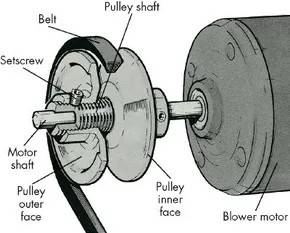
Too much noise? Not enough heat? The culprit might be your blower motor speed. You don’t need a technician to tweak this. A simple adjustment to the blower drive motor pulley can change how your system feels.
Turning the speed up pushes more warm air into your rooms. Turning it down makes the unit whisper-quiet. The trick lies in the setscrew and the pulley position on the driveshaft.
Tools and Safety First
Grab a screwdriver that fits the setscrew snugly. A mismatched tool will strip the screw head and leave you frustrated.
Before touching anything, turn off the furnace power. Safety first. You don’t need to pull the whole unit apart, just access the motor compartment.
Increasing Blower Speed
You want more airflow? Loosen the setscrew holding the pulley to the driveshaft. Don’t remove it. Just back it out enough so the pulley can turn.
Turn the pulley clockwise. One full rotation is a good starting point. Tighten the setscrew back down firmly.
Test the system. Does the air feel stronger? If you need even more speed, try two clockwise turns. Tighten the screw again.
Decreasing Blower Speed
Too loud? The opposite works just as well. Loosen the setscrew. Turn the pulley counterclockwise.
One turn down reduces the speed. Tighten the screw. Run the furnace and listen.
If it’s still too noisy, try two counterclockwise turns. Tighten securely.
“Small changes in pulley position can have big effects on comfort and noise levels.”
Why Does This Matter?
A higher blower speed means faster heating. It pushes air through the ducts more aggressively. Lower speed means less wear on the motor and quieter operation.
Where should you start? One turn in either direction is safe. Test before making bigger adjustments.
Which direction should you turn? Clockwise for faster. Counterclockwise for slower. Simple rules apply here.
Does your furnace have a variable speed motor? If so, this manual adjustment won’t work. This guide applies to fixed-speed systems with a single motor and pulley setup.
Final Checks
Always tighten the setscrew fully after adjusting. Loose screws cause vibration. Vibration causes noise. Noise causes problems.
Run the furnace for a few minutes. Check for unusual sounds. Feel the air output. Adjust again if needed.
One turn might be perfect. Two turns might be too much. It depends on your ductwork and fan blade condition.
How far should you push it? Until the air feels right. Until the noise disappears. Don’t overdo it. More speed isn’t always better.
The pulley sits on a shaft. The shaft spins the fan. Change the pulley position, change the gear ratio. That’s the basic mechanics at play here.
What happens if you turn it too far? The motor might strain. The fan might wobble. Stop before you reach that point.
Small tweaks yield big results. That’s the beauty of simple mechanical systems. You control the airflow. You control the noise.
Just remember: power off. Screwdriver ready. Turn clockwise for speed. Counterclockwise for quiet. Tighten. Test
Fixing Misaligned Pulleys
Noise. Heat loss. Efficiency drops. These are the usual symptoms when your forced-air system’s motor and blower pulleys fall out of whack. It is a simple mechanical failure with loud consequences.
Start by checking the alignment. You do not need fancy tools. Grab a carpenter’s square. Hold it against the outside of both the motor pulley and the blower pulley. They need to sit in a straight line. The pulleys must also be at right angles to the motor shaft. If the square touches both evenly, you are good. If not, you have work to do.
Loosening the pulley is the first step if things look off. Find the setscrew holding the motor pulley in place. Loosen it. Move the pulley backward or forward until the lines match. Slide it until the square bridges both without gaps.
Sometimes the setscrew fights back. Rust. Jamming. Stuck threads. If the screw won’t budge, do not force it and break the shaft. Instead, target the motor itself. Loosen the mounting bolts on the motor housing. Slide the entire motor backward or forward. This shifts the alignment. You are moving the whole unit, not just the pulley, to get the geometry right.
A misaligned pulley doesn’t just make noise. It drags down your system’s efficiency. Fix it fast.
Once the pulleys are lined up, tighten everything back down. The setscrew first. Then the motor mounting bolts. Check the square again. Verify the right angle. You want it tight. You want it true.
This mechanical tweak addresses one root cause of poor performance. But forced-air systems have other secrets. Noise often bleeds into the rooms. Heat escapes through the ducts. These are separate issues. They require different fixes. We will tackle those next.