You have a jar. You wrap it in foam. You have a decent cooler. But you do not have a thermos.
Insulation is a two-step process. First, the plastic in the foam is a poor conductor of heat. Second, the air trapped inside the tiny bubbles of that foam is an even worse conductor. Conduction is reduced. The air bubbles also break up any potential convection currents. Heat transfer through foam is small.
But foam is not the end of the story.
A vacuum is a better insulator. A vacuum means a lack of atoms. A perfect vacuum has zero atoms. You cannot create a perfect vacuum, but you can get close. Without atoms, you eliminate conduction and convection completely.
The Glass Vacuum Chamber
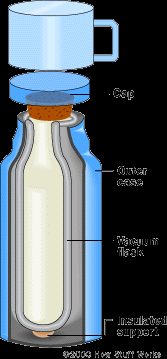
Inside a standard vacuum flask, you find a glass envelope holding a vacuum. The inner vessel is glass. Around that glass is the vacuum space.
Glass is fragile. So you encase it in a plastic or metal case. Many thermoses allow you to unscrew and remove this inner glass envelope. You can inspect it. You can see the break in the seal.
The design goes one step further. The glass is silvered. It acts like a mirror. This reduces infrared radiation. The combination of the vacuum and the silvering cuts heat transfer by convection, conduction, and radiation.
Why Your Coffee Cools Down
A vacuum flask is not perfect. It does not stop heat transfer. It just slows it down.
Hot things in a thermos cool down. Why? Two paths.
- The cap. This is the big one. Heat escapes through the lid.
- The glass neck. Heat conducts through the glass at the top where the inner and outer walls meet.
These paths are small. They are not zero.
Does It Matter if It’s Hot or Cold?
No. The thermos does not know the temperature of the fluid inside. It is just limiting heat transfer through the walls. This keeps the fluid’s temperature nearly constant for a long time.
Whether you pour in boiling coffee or ice water, the physics is the same. The vacuum stops the heat from moving. The silvering stops the radiation. The cap is the weak point.
You buy a thermos to buy time. Not to break the laws of physics.