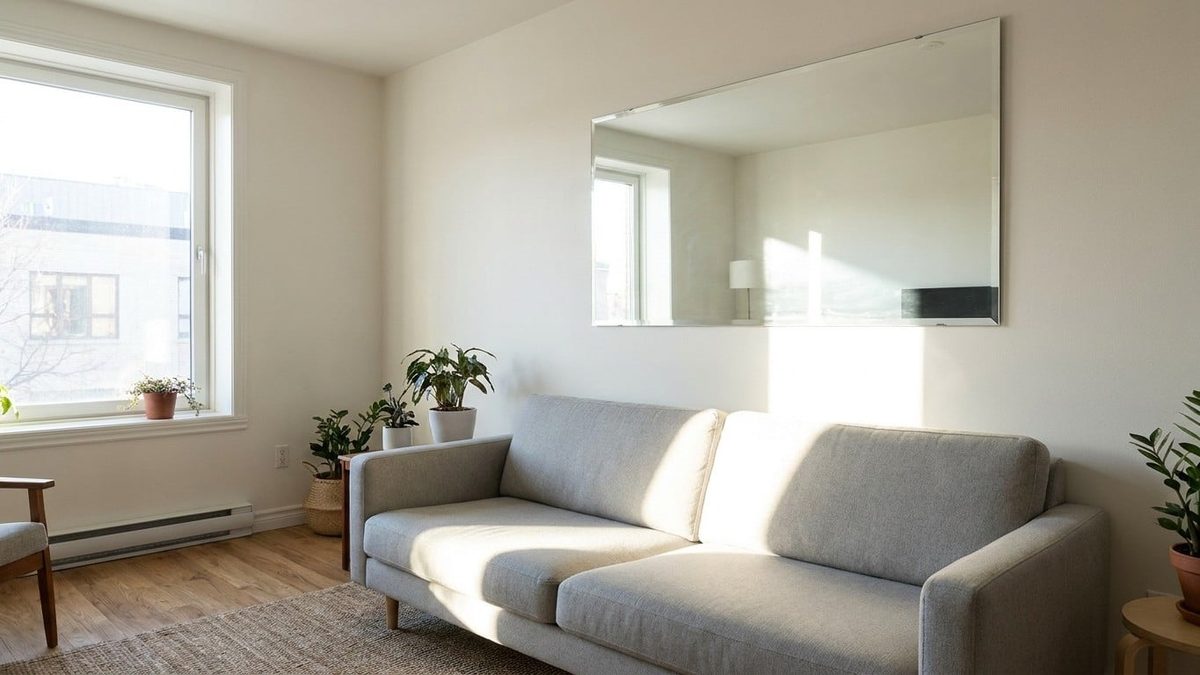
It’s 3 PM. The sun cuts through the living room window, hits a mirror, and blasts a white-hot halo directly onto the sofa. You squint. You shift positions. You realize the room feels less like a sanctuary and more like an interrogation room.
This is a classic decorating mistake. Professionals call it placing a mirror directly opposite a light source. It turns a tool meant to brighten a space into a portable spotlight. The logic behind the move seems sound at first. Mirrors don’t create light; they redistribute it. Put it in front of a window, and it catches the day, projecting it into the heart of the room. On paper, doubling the clarity sounds like the perfect solution.
But daylight isn’t constant. It’s gentle in the morning. By afternoon, especially in south-facing rooms, it becomes an aggressive beam.
Why Facing the Window Backfires
The problem is simple optics, often ignored until it hurts. When you place a mirror directly facing a window, you aren’t just reflecting the view. You are reflecting the intensity of the sun itself.
Over an entire afternoon, this causes cumulative eye strain. You squint without realizing it. You avoid sitting in the best spot. You finally close the curtains, defeating the purpose of the mirror entirely.
This happens everywhere. Entries are notorious for it. A full-south glass door with a mirror straight ahead creates a direct beam of light at specific hours. In a compact living room, the larger the window, the worse the glare. Unlike a lamp, which you can switch off, a misplaced mirror punishes you every single day at the same time.
The Decorator’s Secret: The Perpendicular Wall
So, what’s the fix? Almost every interior designer follows the same rule: hang the mirror on a wall perpendicular to the window.
It feels counter-intuitive. You want to face the light source head-on to grab its energy, right? Wrong. A 90-degree angle is enough to capture the rays while dispersing the reflection. Instead of concentrating the light into a blinding point, the mirror scatters it softly across the room.
This isn’t a feng shui trend or a fleeting style. It’s a fundamental principle for managing brightness in living areas. The perpendicular wall acts as a compromise. You gain that airy, open feel without getting a direct ray in your eyes during your afternoon coffee.
There is an alternative for deeper rooms. Placing a large mirror on the wall opposite the window (but far enough away) can create significant visual depth. The eye is drawn to the reflected light, making the space feel larger. But in a tight living room where the sofa is close to the opposite wall? The distance isn’t enough to diffuse the glare. That’s when the perpendicular approach wins.
Correcting the Placement Without Renovation
You don’t need to repaint or redecorate to fix this. A simple shift often does the trick.
Move that mirror to the side wall—the one touching the window at a right angle. But pause. Check what the mirror will actually reflect. A mirror should bounce back beauty or light, not an exposed electrical outlet or an ugly radiator.
Height matters too. Center the mirror at eye level, roughly 150 to 160 cm from the floor. Too high, and you’re staring at the ceiling. Too low, and you’re looking at the floor and the bottom of your furniture.
Consider the furniture layout as well. If your sofa faces the new perpendicular wall, the window’s reflection will appear diagonally. It’s soft. It’s diffuse. It’s pleasant.
One detail most guides miss: seasons change. A southwest-facing room gets low, raking sun in winter. This light can travel far, even hitting a mirror on a perpendicular wall if the angle is slightly off.
Before you drill new holes, do this free test. Lean the mirror against different walls. Stay in the room. Watch how the light moves at 10 AM, noon, and 4 PM. Do it for a week. It’s reversible. It costs nothing. And it saves you from making a permanent mistake on a temporary problem.
Sources: mabulledeco.com | passion-maisons.fr