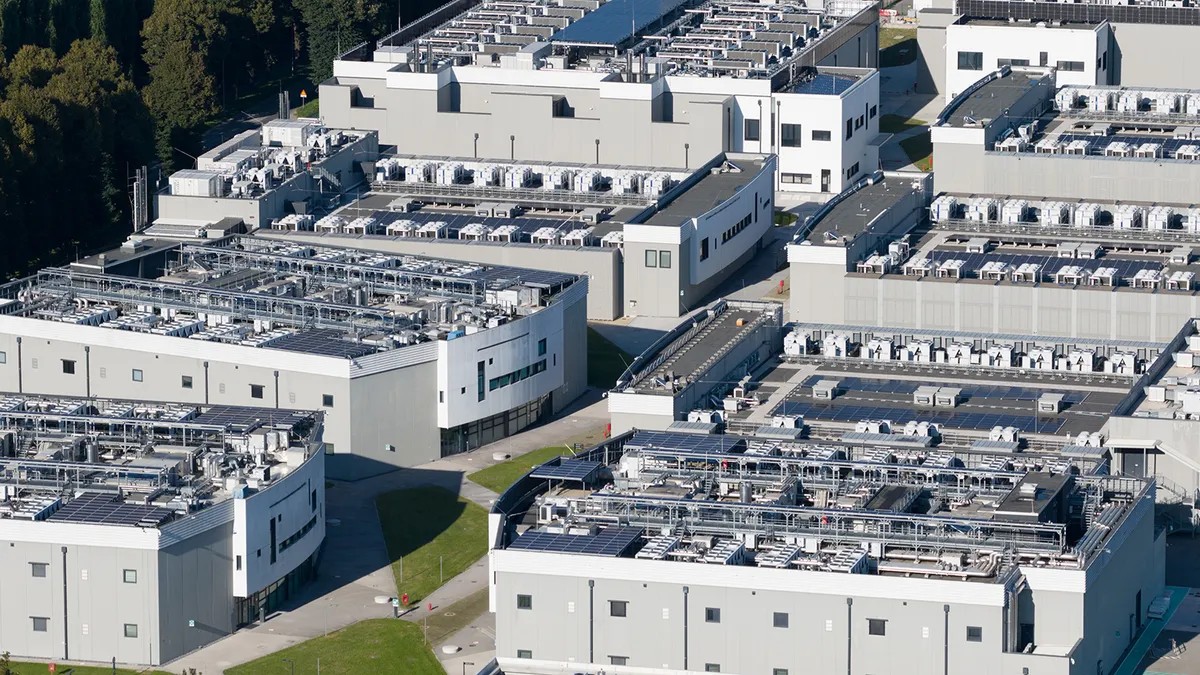
Data centers are the invisible backbone of the modern world. They power everything from global financial markets and government databases to the burgeoning demands of Artificial Intelligence (AI). As of 2025, the United States leads the global market with 2,396 operational data centers, a figure driven by the explosive growth of cloud computing and digital services.
Because these facilities serve different purposes, “size” is a relative term. Industry experts measure them in two primary ways: physical footprint (square footage) and power capacity (megawatts/gigawatts). While a massive building provides space, it is the power capacity that determines how much computational work—such as training AI models—a facility can actually perform.
Landmark Facilities: Size vs. Connectivity
Two specific facilities stand out as icons of the industry, each representing a different strategic advantage.
Switch TAHOE RENO 1 (Nevada)
Spanning a massive 1.3 million square feet, this is widely considered the largest single data center building in the U.S.
* The Advantage: Nevada offers a combination of competitive energy costs and access to renewable resources.
* The Strategy: For operators, Reno provides the physical scale necessary for massive data storage while maintaining high levels of security and sustainable power.
350 East Cermak (Chicago)
While slightly smaller in footprint at 1.1 million square feet, this facility is a powerhouse of interconnection.
* The Advantage: Located in the Midwest, it serves as a critical bridge between the East and West Coasts.
* The Strategy: It is a primary hub for cloud providers and financial institutions that require ultra-low latency —the speed at which data travels—to execute rapid-fire digital transactions.
The Major U.S. Data Center Markets
Beyond individual buildings, entire geographic regions have evolved into specialized “hubs.” The following markets are the most influential in the country:
1. Northern Virginia: The Global Capital
Northern Virginia is the undisputed heavyweight of the industry. By 2025, its total inventory reached 4,039.6 MW.
* Why it matters: Its proximity to Washington, D.C., makes it the primary choice for government agencies, while its dense fiber-optic networks attract the world’s largest cloud providers like Equinix and Digital Realty.
2. Dallas–Fort Worth: The Strategic Midpoint
Positioned between the tech giants of Silicon Valley and the political hub of Northern Virginia, Dallas has seen explosive growth.
* The Trend: Capacity surged from 710 MW in 2020 to nearly 1,650 MW by mid-2024, acting as a vital link for national network connectivity.
3. Atlanta: The Rising Star
Atlanta has emerged as one of the fastest-growing markets, boasting 1,279.4 MW of capacity in early 2025.
* The Drivers: A mix of favorable tax incentives, competitive power costs, and a robust business ecosystem is drawing tech companies toward the Southeast.
4. Chicago: The Central Distribution Hub
With roughly 130 data centers and 1,120 MW of capacity, Chicago serves as a central node for national internet traffic. Its strength lies in its highly skilled workforce and deep fiber connectivity.
5. Phoenix: The Low-Risk Alternative
Phoenix maintains a 617 MW inventory.
* The Appeal: Beyond competitive energy costs, many operators choose Phoenix because it is located in a region with a significantly lower risk of natural disasters compared to coastal hubs.
6. Silicon Valley: The Innovation Engine
As the birthplace of much of the world’s software, Silicon Valley remains an influential market with nearly 150 facilities.
* The Challenge: Despite its proximity to tech giants, the region faces headwinds from rising power costs and energy constraints, forcing some new developments to move to other states.
7. Miami: The Gateway to the Americas
Miami serves a unique geopolitical role. Through the Network Access Point (NAP) of the Americas, it acts as the primary digital gateway connecting the U.S. to Latin America, the Caribbean, and Europe.
Summary
The U.S. data center landscape is diversifying: while Northern Virginia dominates in sheer power, regions like Miami and Chicago provide critical connectivity, and markets like Phoenix and Reno offer stability and scale. As AI continues to demand more electricity and space, the competition between these hubs will likely intensify.