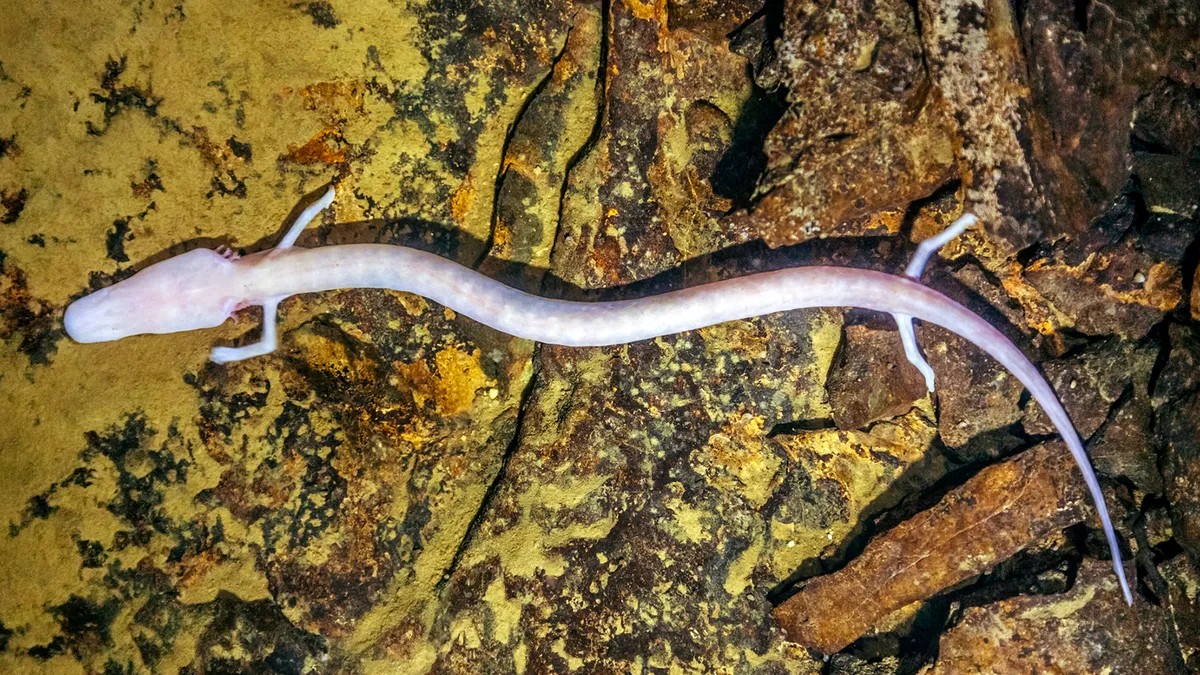
The olm (Proteus anguinus ), a bizarre amphibian dwelling in the subterranean darkness of southeastern Europe, represents one of nature’s most remarkable adaptations. Often called the “human fish” due to its pale, almost translucent skin, this creature isn’t just a curiosity; it’s a living laboratory for understanding life in extreme environments.
A Life Shrouded in Darkness
Unlike typical amphibians that require surface life stages, the olm spends its entire existence in underwater cave systems. These aren’t just any caves; they’re permanent darkness habitats where sunlight never penetrates. This isolation has driven the species to evolve in ways few other vertebrates have. The olm is Europe’s only cave-dwelling vertebrate that lives its whole life underwater, making it an evolutionary outlier.
Sensory Adaptations to a World Without Light
The olm’s eyes are underdeveloped and covered by skin, rendering them functionally blind. Instead of vision, it navigates and hunts using highly specialized senses. It detects vibrations, chemical cues, and even faint electric fields via receptors in its inner ear and along its body.
The absence of light has shaped every aspect of the olm’s biology, forcing it to rely on senses we often take for granted.
This is significant because it shows how extreme conditions can drive radical evolutionary shifts. Species in complete darkness don’t need eyes, but they must have alternative ways to perceive their surroundings.
Slow Living in a Stable World
The olm’s cave environment is remarkably stable in temperature year-round, allowing it to conserve energy and live for an extraordinarily long time. Some individuals may live over 60 years, making it one of the longest-lived amphibians on Earth. This longevity is tied to its slow metabolism and infrequent feeding. It can survive for years without eating, a necessity in a food-scarce environment.
Reproduction and Conservation
The olm’s reproductive habits are as unique as its lifestyle. Females breed infrequently, often only once every few years, laying eggs in crevices within the cave. The larvae develop directly into adult form without a land-dwelling phase, completing the entire life cycle underwater.
However, this unique species is vulnerable. Pollution and human disturbance of underground water sources threaten the olm’s survival. Its conservation status reflects its rarity and the fragility of its habitat. Projects like the Proteus Genome Project are underway to understand its evolution, but protection of its cave ecosystems is critical.
The eyeless olm is more than just a strange creature; it’s a reminder of how life adapts to even the most extreme conditions. Its existence challenges our assumptions about how animals survive, and its future depends on preserving the dark, hidden world it calls home.