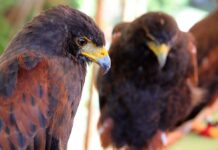
Falcons, the swift and powerful birds of prey, stand out in the avian world not just for their hunting prowess but also for the unique way they’re grouped: a “cast.” Unlike geese forming a flock or turkeys a gaggle, falcons don’t gather in large, boisterous crowds. The term “cast” originates from the historical practice of falconry, where trained birds were released in small groups, typically pairs or trios, for hunting.
Why “Cast”? The Historical Connection
The use of “cast” isn’t accidental. It reflects the deliberate, controlled nature of falconry – a tradition where humans have worked closely with these birds for centuries. While falcons rarely congregate in large numbers in the wild, the term persists as a nod to their history with humans. This highlights how collective nouns often aren’t about natural behavior, but rather human observation and interaction with animals.
Raptors and Their Unique Groupings
Falcons are part of a larger family of raptors including hawks, eagles, and owls. Other bird species also have their own distinct group names:
- A murder of crows
- A parliament of owls
- A skein of geese in flight (versus a gaggle on land)
- A covey of quail
- A waddle of penguins
These collective nouns aren’t random; they often reflect the bird’s behavior, appearance, or historical associations. For instance, the term “unkindness” for a group of ravens hints at their scavenging nature.
Falcon Behavior: Solitary Hunters
Peregrine falcons, among the fastest creatures on Earth, typically hunt solo. They don’t rely on group tactics like some other predators. However, temporary groupings may occur during migration or when prey is abundant. These smaller gatherings still fall under the “cast” designation, even if the birds aren’t actively coordinating.
The Broader Significance of Collective Nouns
Collective nouns for animals aren’t just curiosities. They reveal how humans have perceived and categorized the natural world for centuries. These terms offer glimpses into ancient language, cultural practices, and even the ecological roles of different species.
Collective nouns for birds are both practical and poetic, giving insight into behavior and appearance.
Ultimately, the “cast” of falcons is a reminder that even in the wild, human history and observation have left their mark on how we understand the natural world.