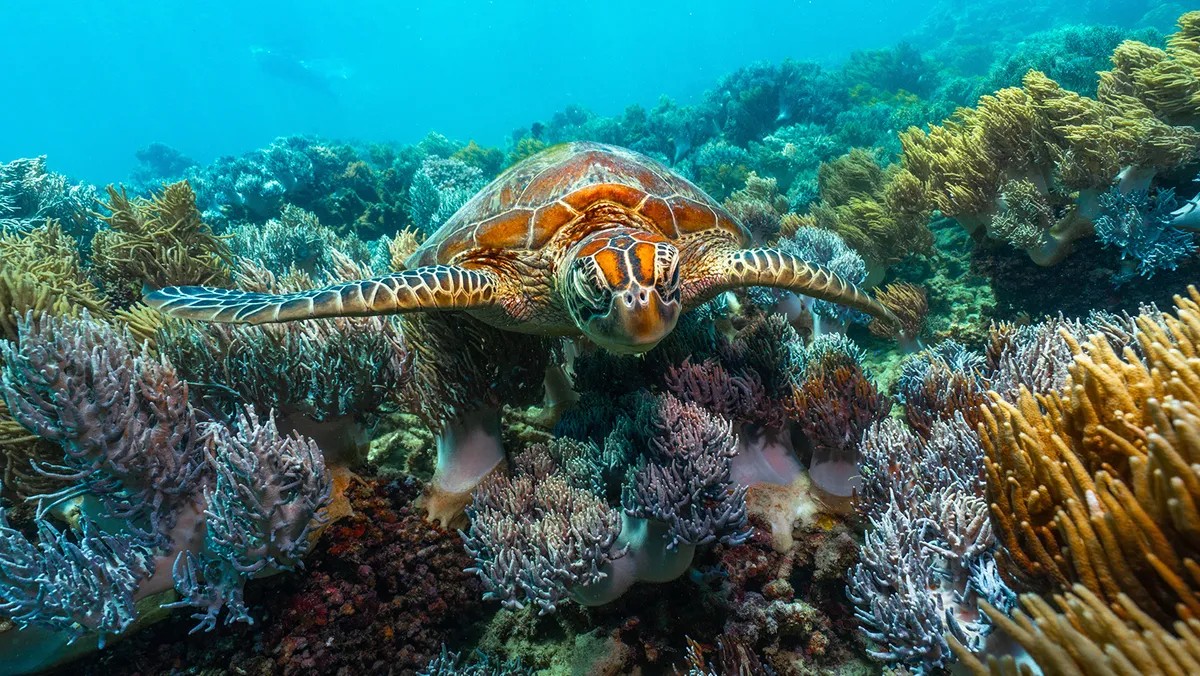
Coral reefs are often described as the “rainforests of the sea,” but that comparison only scratches the surface. Though they occupy less than 1% of the ocean floor, these biological powerhouses support roughly 25% of all marine life.
Beyond their biological importance, reefs are essential economic and physical infrastructure. They act as natural storm buffers for coastal cities, provide food security for millions, and drive a global tourism industry worth approximately $36 billion annually. From the massive barrier systems of Australia to the delicate atolls of the Maldives, these ecosystems are the lifeblood of our oceans—and they are under unprecedented pressure.
The World’s Most Significant Reef Systems
To understand the scale and diversity of these ecosystems, we can look at nine standout regions that illustrate different ecological roles and challenges.
1. The Great Barrier Reef (Australia)
As the world’s largest reef system, stretching over 1,400 miles, this is the ultimate example of a barrier reef. It runs parallel to the coast but is separated by deep water. While it demonstrates how massive scale can be achieved through year-over-year calcium carbonate growth, it also serves as a global warning sign; warming waters and invasive species like the crown-of-thorns starfish are rapidly altering its condition.
2. The Coral Triangle (Southeast Asia & Pacific)
Spanning Indonesia, Malaysia, the Philippines, Papua New Guinea, Timor-Leste, and the Solomon Islands, this region is the biodiversity heavyweight of the planet. It is unique because its health relies on a “connected” ecosystem: corals, seagrass beds, and mangroves must all thrive together to support the complex food chain.
3. Raja Ampat (Indonesia)
Located within the Coral Triangle, Raja Ampat is often used by scientists as a gold standard for reef health. With over 1,500 fish species and 550 coral species, it proves that high biodiversity is possible when coastal development is limited. However, it also highlights the “tourism paradox”: while visitors fund conservation, poorly managed tourism can cause physical damage to the reefs.
4. The Mesoamerican Reef (Western Hemisphere)
The largest reef in the Atlantic, stretching across Mexico, Belize, Guatemala, and Honduras, this system is vital for coastal protection. By absorbing wave energy, it protects shoreline communities from erosion and storm surges—an “ecosystem service” that is invaluable to human safety.
5. The Red Sea Coral Reef
The Red Sea is a critical site for climate research. Unlike many other reefs, certain corals here have shown a remarkable ability to tolerate unusually warm water. Scientists are studying these “heat-tolerant” species to see if their genetic traits can be used to help restore damaged reefs elsewhere.
6. The Maldives (Indian Ocean)
The Maldives is defined by atolls —ring-shaped reefs that form around submerged volcanic islands. These structures create calm lagoons that support massive fisheries and tourism. However, because atolls have very little elevation, they are among the most vulnerable regions on Earth to rising sea levels.
7. Caribbean Fringing Reefs (Virgin Islands & Caribbean)
Unlike barrier reefs, fringing reefs grow directly from the shoreline. Because they sit in shallow water, they are highly sensitive to local stressors like land runoff, pollution, and extreme heat during low tides.
8. The Solomon Islands
In this region, the connection between reef health and human survival is most visible. The reefs are central to the cultural identity and food security of local villages, making community-based conservation essential to their survival.
9. Papua New Guinea
This region exemplifies ecosystem connectivity. By combining barrier, fringing, and patch reefs with mangroves, Papua New Guinea creates a seamless web of habitats. This connectivity is what allows energy to flow from tiny coral polyps up to the largest ocean predators.
The Looming Crisis: A System Under Stress
Despite their resilience, coral reefs are facing a “perfect storm” of threats. We are currently witnessing the fourth global bleaching event, a phenomenon triggered by rising ocean temperatures. When water becomes too warm, corals expel the symbiotic algae living in their tissues, leaving them white and vulnerable to disease and death.
The challenges are both global and local:
– Global Threats: Ocean acidification (which makes it harder for corals to build skeletons) and rising sea temperatures driven by greenhouse gas emissions.
– Local Threats: Overfishing, plastic pollution, destructive fishing practices, and poorly planned coastal development.
Looking Ahead: Can We Save the Reefs?
While the situation is dire, the tide is not yet lost. Conservationists are employing various strategies to bolster reef resilience, including:
* Coral Farming: Growing resilient coral fragments in nurseries to replant on degraded reefs.
* Marine Protected Areas (MPAs): Creating “safe zones” where fishing and development are restricted.
* Sustainable Tourism: Implementing stricter rules to prevent physical damage to shallow waters.
The Bottom Line: While local restoration efforts like coral farming are vital, they are ultimately “band-aids” unless the root cause—global carbon emissions and ocean acidification—is addressed.
Conclusion
Coral reefs are irreplaceable biological engines that protect our coasts and feed billions. Their survival depends on a dual approach: aggressive global action to combat climate change and rigorous local management to protect the delicate habitats that remain.